Contributor

Many small tributaries originating in Sinharaja flow into larger rivers, supporting lowland ecosystems and human communities downstream.
Sinharaja is a wet zone rainforest located in Southwest Sri Lanka, about 90km SE from Colombo. This belongs to Sabaragamuwa and Southern provinces, bounded by several rivers (Ging Ganga and Kalu Ganga) and tributaries.

On the way from Matara to Sinharaja, Dasawanguwa is a stretch of sharp bends surrounded by forest and hills. Then Patna follows with open grasslands and cool air, offering a peaceful pause.
There are three designated access paths into the forest reserve. They are; Kudawa entrance (Colombo – Kalawana _ Kudawa), Pitadeniya entrance (Galle or Matara - Deniyaya - Pitadeniya), Morning Side Entrance (Galle or Matara – Deniyaya – Morning Side Estate).

As you walk deeper into the forest, you’ll find giant dipterocarp trees, mix species foraging flocks and reptiles. With a keen eye, you may spot snakes and reptiles that are perfectly camouflaged within the forest’s patterns.
Sinharaja has both primary and secondary components. Primary forest represents undisturbed areas with closed canopy and emergent trees. Secondary forest has developed in areas that has previously disturbed by activities like selective logging. Once you enter the Sinharaja rainforest, the outside world will fade away. You will be warmly welcomed by the sharp call of Sri Lankan Blue Magpie, a work of art by nature.

This vertical arrangement is important to use space and resources efficiently.
Sinharaja is not just a mass of trees, it is well layered. The forest is structured into different vertical layers: emergent, canopy, sub canopy, under storey and ground layer. As they receive different amounts of sunlight, moisture and wind, they create unique micro-habitats.

It plays a crucial role in nutrient cycling, as leaf decomposition happens in the under storey.
In the emergent layer you will find towering trees, that rise above the rest and face direct sunlight. Below it, the canopy forms a green roof. The sub canopy and under storey are darker and cooler, thus supports shade tolerant plants and shrubs. Ground layer mostly hosts ferns, fungi and mosses.
Sinharaja forest is as rich in animal life as much as it is in plants. The vegetation, moisture and layered structure makes it an ideal habitat for many species. Among the most prominent groups are birds, mammals including few elephants, butterflies, reptiles and amphibians, including many endemics to Sri Lanka. They actively shape the ecosystem, and their presence indicates the health of the forest.

They act as seed dispersers and insect controllers, helping to maintain ecological balance.
Birds are one of the most common animal groups in Sinharaja, bringing colors and sounds to the dense forest. This forest is home to many endemic species, including white-headed starling, Sri Lanka lorikeet, Yellow fronted barbet and the iconic Sri Lanka blue magpie.

Sri Lankan Blue Magpie
One of the most fascinating bird behaviors in Sinharaja is mixed-species foraging flocks, where birds move through the forest in search of food. Around 60 species may participate in these flocks, with an average of 11 species and about 42 individuals per flock. Orange- billed babbler is the most common species, and often acts as the leader.

Snake
Sinharaja is a stronghold for herpotafauna, including snakes, lizards, frogs and toads. Herpetofauna is a colective name used for reptiles and amphibians.

Frog
Normaly amphibians depend on high humidity and moisture for survival.
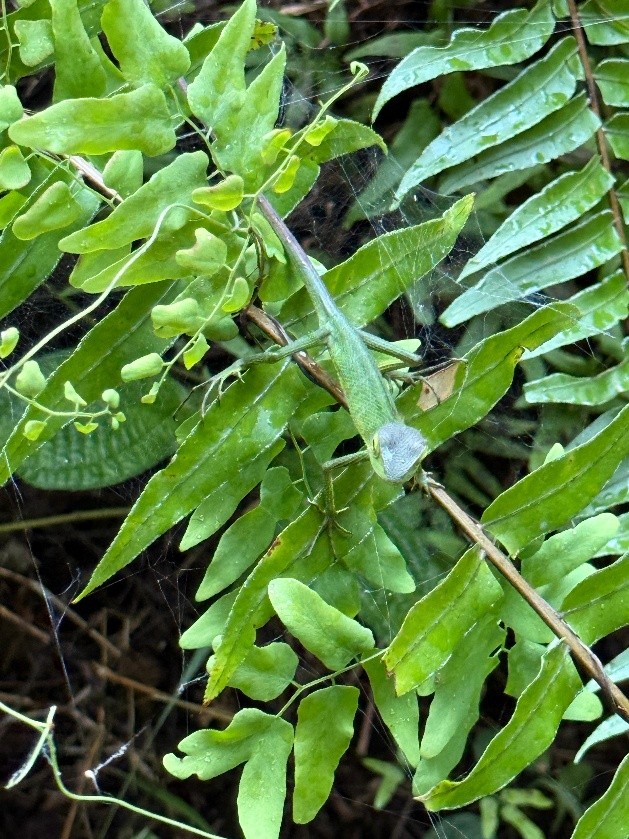
Lizard
This forest makes a good habitat for them with ideal environments.

Lizard
Reptiles such as snakes and arboreal lizards occupy different layers from the ground to the canopy.
For a long time Sinharaja remained protected because of its relative inaccessibility. Large scale human intrusions were discouraged by steep terrain, dense vegetation and heavy rainfall. Today it is well protected as a UNESCO heritage site and a strict nature reserve. But legal protection alone cannot fully shield the forest.
There are many ongoing threats such as encroachment, illegal timber and fuelwood extraction, and the collection of forest products (resins, medicinal plants, edible fruits, mushrooms). Kitul tapping is permitted to a limited extent under regulation. Additional threats are gem mining, illegal camping, and poaching, which disturb and pollute the ecosystem.

Night sky at Sinharaja
If you are visiting Sinharaja, you are not just a tourist, but a temporary guardian of the forest. Responsible travel means staying on designated trails, avoid littering and never removing plants or animals from the forest. Even your small actions like keeping noise levels low, help reduce the stress on wildlife. When travelers act with respect and awareness, they ensure that Sinharaja remains as a living rainforest, not a memory.
By Shavindhi Yapa
Undergraduate, University of Colombo
Environmental science (Hons.)