Contributor
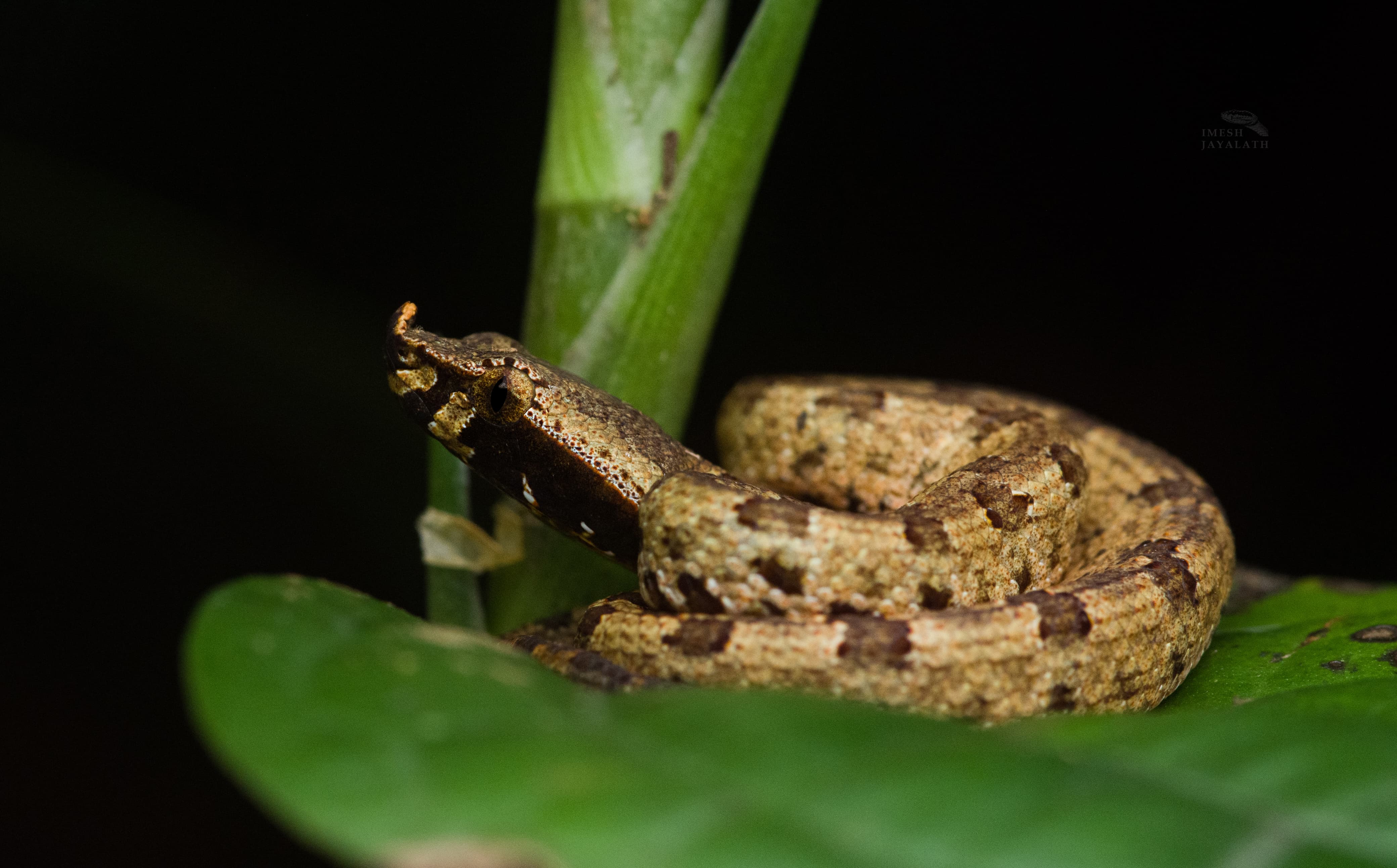
Lowlands Hump-nosed Pit Viper (Hypnale zara)
The Lowlands Hump-nosed Pit Viper (Hypnale zara) is a venomous pit viper endemic to Sri Lanka and one of the three recognized species of the genus Hypnale. It can be distinguished from the closely related Hypnale nepa by its generally more variable body coloration and its relatively less strongly upturned snout. The species has a characteristic rough-scaled appearance, with numerous small scales arising around the wart-like protuberances at the tip of the snout. There are typically 10–19 minute scales on the snout protuberances, 18–39 small and irregular scales between the internasal and prefrontal regions, around six scales bordering the eye, and seven to eight supralabial scales. Its strongly keeled body scales contribute to the rough texture characteristic of hump-nosed pit vipers. The ventral scales number approximately 134–157, while the subcaudals range from about 34–51. Overall coloration is highly variable, ranging from yellowish-brown and brown to occasionally deep reddish tones. The dorsal pattern consists of two rows of conspicuous sub-oval to sub-triangular dark blotches that converge toward the vertebral region, while a dark stripe commonly passes through the eye and extends across the cheek. The underside is considerably paler than the back and may appear light ash-grey. Hypnale zara is a viviparous/ovoviviparous snake, meaning that the developing young are retained within the female until they are sufficiently developed to be born alive, rather than being deposited as conventional eggs. As a member of the hump-nosed pit viper group, it possesses the characteristic adaptations of a pit viper, including venom-delivery structures and heat-sensitive facial pits that assist in detecting suitable prey. Its endemic distribution makes it an important component of Sri Lanka's unique snake fauna, although much of its detailed natural history, including aspects of its feeding ecology, behavior and reproduction, remains less extensively documented than that of some better-studied Sri Lankan snakes. The combination of its variable brown-to-reddish coloration, strongly keeled scales, distinctive dorsal blotches, dark facial stripe and characteristic raised snout makes H. zara a particularly recognizable member of Sri Lanka's endemic venomous snake fauna.